a11y Companion v3.0.0: A Checkmark Isn't Evidence
v2 argued that a contrast tool should refuse to claim what it cannot evaluate. v3 makes the same argument about checklists, and gives every checked box a way to be proven.
In this article
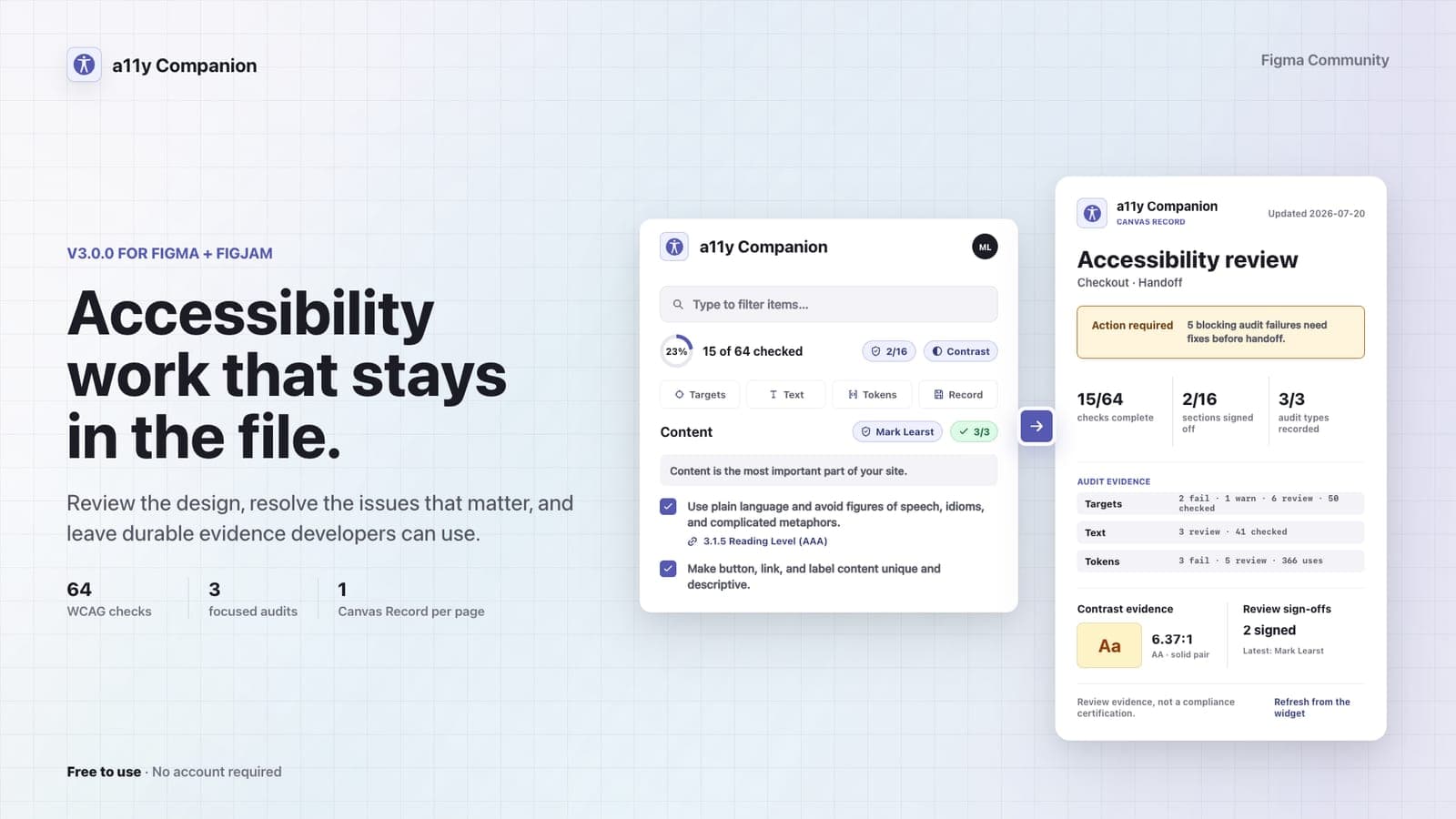
♿️ a11y Companion v3.0.0 is live.
The checklist is still the checklist. What changed is that the widget can now tell you whether the file actually earned the checkmarks.
Source checklist: The A11Y Project. Standards target: W3C WCAG.
The gap I kept running into
v2 was about a contrast tool refusing to claim what it cannot evaluate. Shipping it exposed the next problem, one floor down.
A checked box is a claim, not a measurement.
Nothing in the widget knew whether the file met the criterion sitting next to the checkmark. A team could complete an entire checklist against a file that failed contrast, and the widget would show a full green ring. The checklist was honest about what it asked. It had no way to be honest about the answer.
So v3 asks a different question. Not "did someone check this box," but "what would it take to prove it."
Three things a claim needs to become evidence
It has to reach the people who act on it
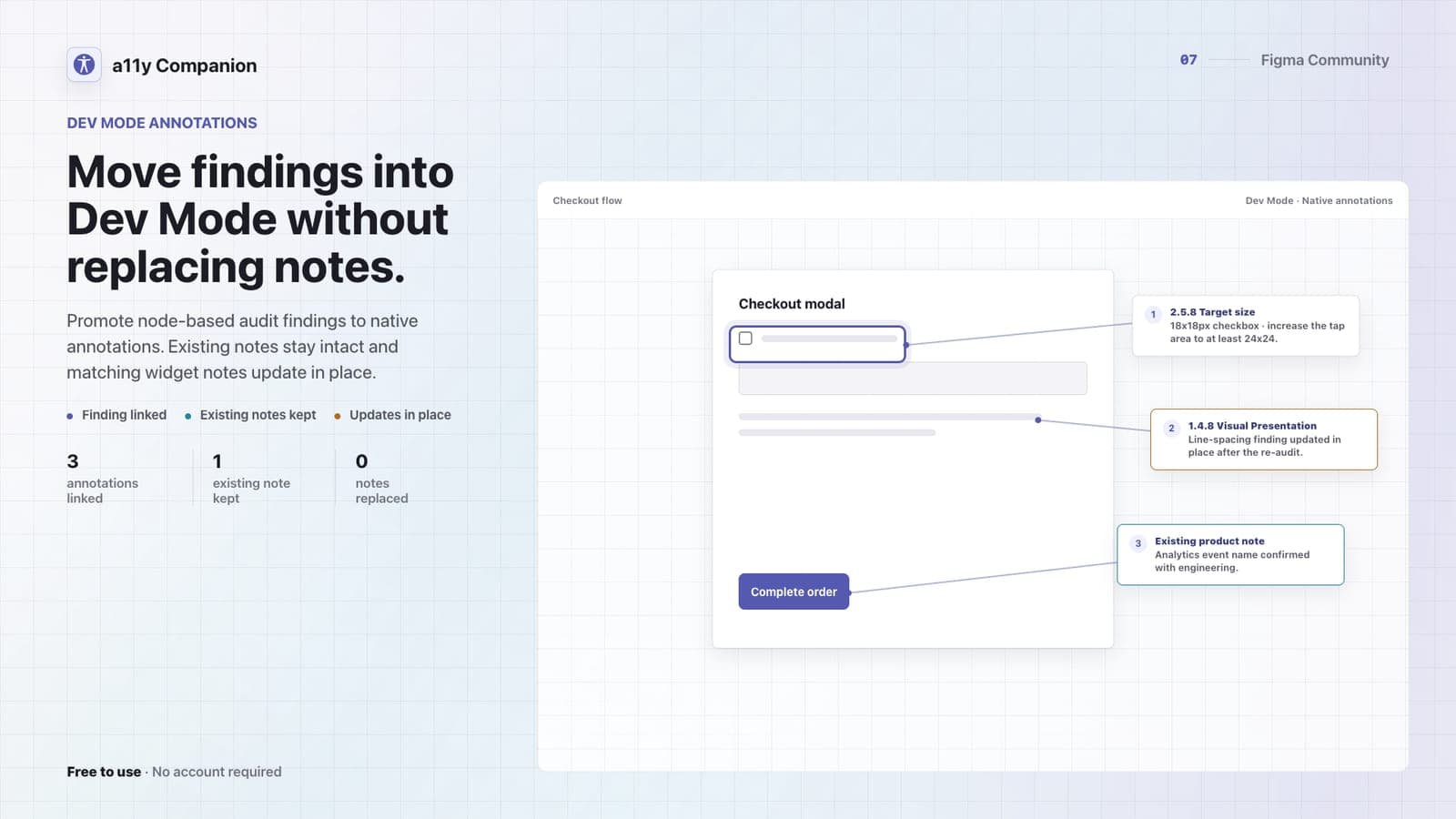
Findings that live inside a widget are findings nobody fixes. v3 promotes audit results to Figma's own Dev Mode annotations, with the WCAG Understanding page linked and the failing property named: width, height, fill, font size, line height.
It reads and rewrites the annotation array rather than replacing it, so annotations you wrote by hand survive, and running the same audit twice does not produce two copies.
It has to expire
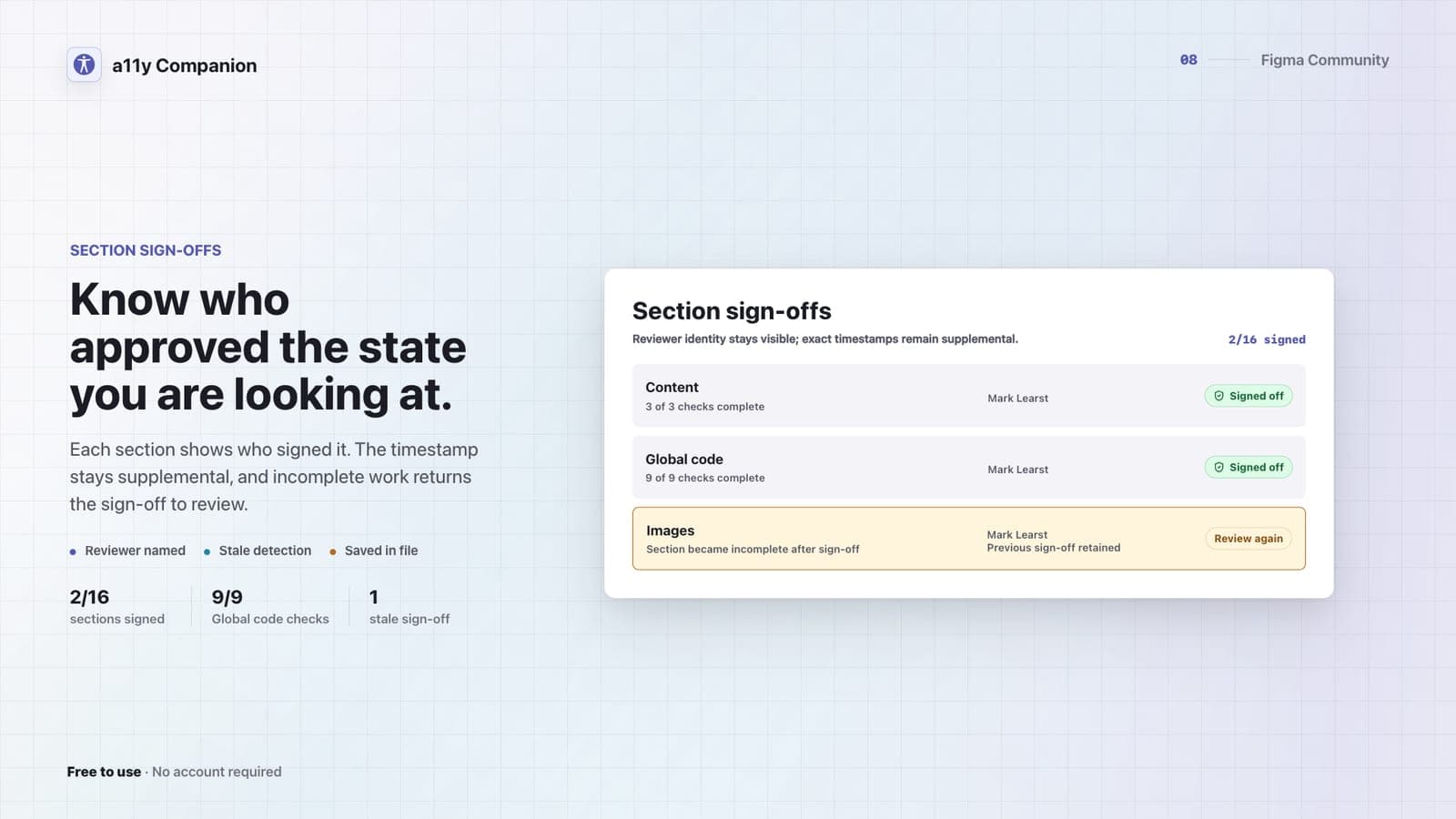
A sign-off that outlives the design it approved is worse than no sign-off, because it looks like diligence.
When you sign a section in v3, the signature records what it actually reviewed: item ids, completion state, and the checklist revision. Change items underneath a signed section and the stamp turns amber. The approval does not quietly stay valid.
It has to leave the file
A review that only exists in one Figma document stops being useful the moment anyone needs it elsewhere.
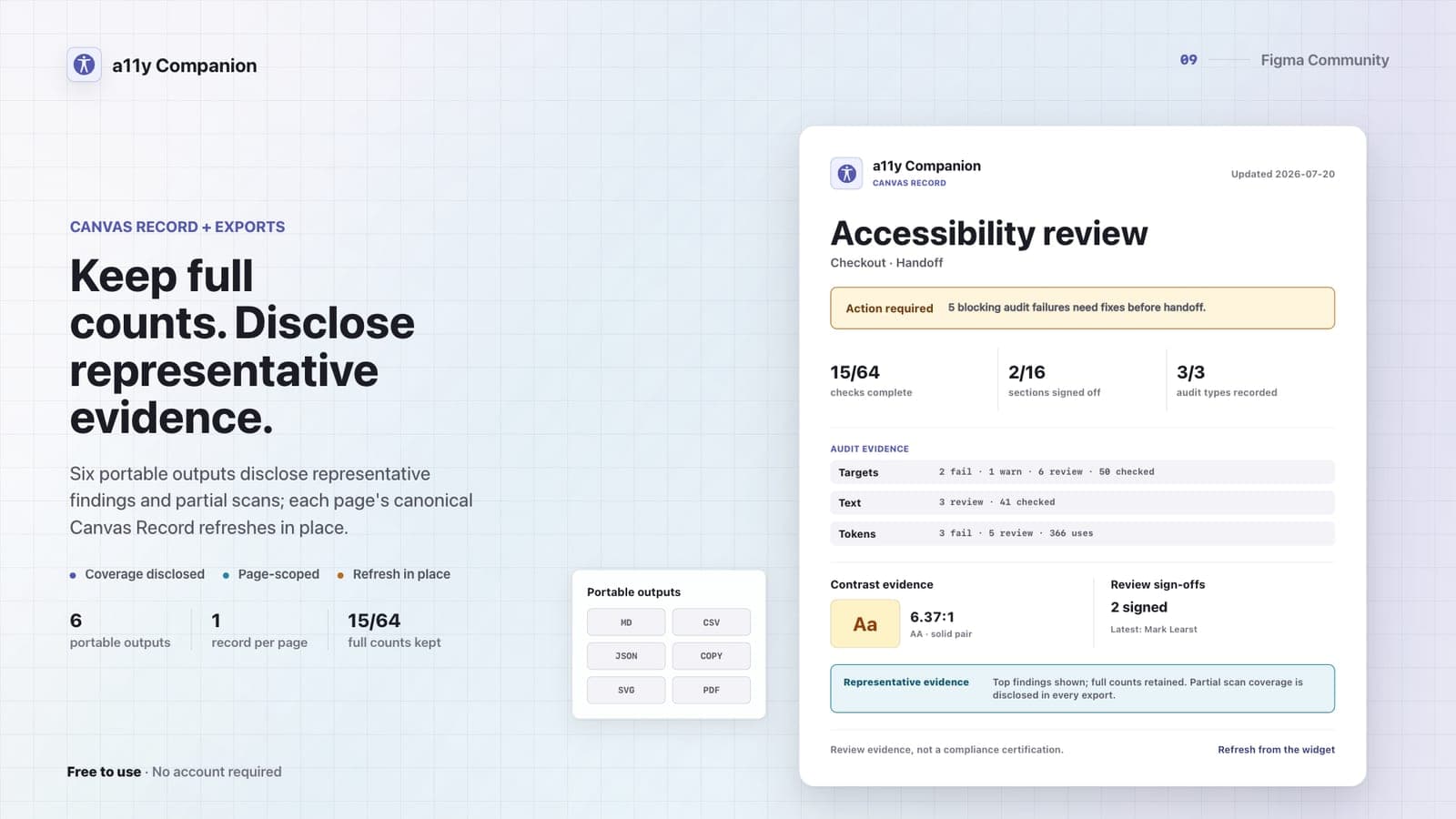
v3 compiles a Canvas Record, one Figma frame holding progress, sign-offs, audit summaries, contrast evidence, and priority findings. Re-running it refreshes the same frame instead of littering the page with copies. The same review exports as Markdown, CSV, or JSON.
What's new in v3.0.0
- Three on-canvas audits: Targets, Text, and Tokens, run from under the progress ring
- Live contrast watching that re-checks the selection as it changes, with shared ownership so the team sees who is driving
- Color vision preview for protanopia, deuteranopia, and tritanopia
- WCAG level filters, including a "New in 2.2" filter for the nine criteria WCAG 2.2 added
- Native Dev Mode annotations, individually or in bulk
- Canvas Record, exportable as SVG or PDF
- Evidence-bound section sign-off
- Report export as Markdown, CSV, or JSON
- Twenty locales, up from thirteen
Where it still says no
The honesty argument only holds if the tool applies it to itself. Three places v3 refuses to overstate:
- Audits share a capped slot. Past the cap, the counts stay truthful rather than reporting only what fits on screen, and the Canvas Record will not call itself ready on capped evidence.
- Reports disclose when their rows are representative rather than complete. A grouped root cause is labeled as one.
- The color vision preview is a simulation, not a second grade. WCAG contrast stays the normative result. Three more pass/fail badges would feel more thorough and mean less.
Contrast thresholds are also evaluated at full precision, so a pair sitting just under the line cannot round its way into a pass.
I ran it on itself
v3 had to pass its own checklist. That caught real problems: checkboxes that failed WCAG 1.4.11 non-text contrast, severity conveyed by color alone, and WCAG references that rendered wrong in dark mode.
Testing the token audit against Vercel's Geist file caught another one. My pairing logic looked for names containing "text" and "bg", which found roughly twelve pairs in a system named gray/100 through gray/1000. It now infers role from the trailing numeric step instead.
Being wrong in a way you can measure is the whole point.
Why I keep tightening this
I wrote in the v2 post about being the eyes and ears for my legally blind and deaf brother. That has not changed, and neither has why it matters here.
Compliance language never helped him. Working designs did. That is why v3 went after evidence instead of more checkboxes.